Two murders, few answers
How do I meet this moment?

Hello, Friends.
This week I was consumed with crime. On Monday and Tuesday, I spent time researching our government’s pervasive surveillance of the American public, including here at home where a set of Flock Safety cameras were installed without much public fanfare.
On Wednesday, I met with the Chief and Asst Chief of Police to discuss it. They claimed Flock’s license plate technology makes them better at their jobs, and gave me a list of crime statistics from their department since using the cameras. Thank you, but I thought I needed more data on Flock-assisted crime solving across the nation. It was my plan for the remainder of the week to gather more data.
It was on Thursday of this week, though, when I found myself swept up in the flow of events to do with a double homicide in our sweet little town where murder isn’t what people wake up and think will happen to them as they go to work and plan dinner for that night, and text friends about what they should do over the weekend.
I have never covered such a visceral federal crime before. Because this was an armed robbery of a bank, in came the FBI. The assailant, a kid—just 18 years old!—killed a father of three, killed a young newlywed beloved in town. There is so much that is unclear, and as the reporter in town, I will be seeking answers. It’s a long road ahead of me. There will be two trials, one in a federal court for armed robbery, and another in our circuit court for homicide.
The murderer, he fled the bank on foot, and what happened next, though reported one way by the FBI, well, I am just not sure what to think: how did he go undetected through our town streets? After a bit, there was quite a lot of high speed chasing, a wrecked car, and then a wee hours of the morning, hours-long manhunt on foot through horse farm country farther north of here. And of course, the authorities had used a Flock camera image to help locate him.
I received a harbinger of this horrible mess last week when I attended a dinner held at the conclusion of a leadership conference. I was sat with the former publisher of a big paper. He’d asked me what the hardest story was that I’d ever covered in my career. I’d never been asked that before. I told him about the time when I was starting out and had to cover a court ruling in southern New Jersey.
It was about a young man’s death. The jury had rejected manslaughter even though the parents swore it was murder. The mom cried through the entire interview and being a young woman I, a) couldn’t comprehend why my editor needed me to cover fresh grief as a story, and b) couldn’t find a way to comfort the mom who had to endure my horrible questions, ones I wasn’t even sure were relevant or newsworthy.
Now, the crime was unfolding and I needed to alert the town about a lock down and a killer on the loose. Who should I contact first? I didn’t know. So I made friends with new cops and troopers, and relied on my already-friend cops, and through the wee morning hours, was getting texts from them so I could keep the story updated.
Once the young killer was caught, I was put in a new situation, like I was before years ago, near Vineland, NJ, needing to ask traumatized survivors questions about their person who is now gone from this planet.

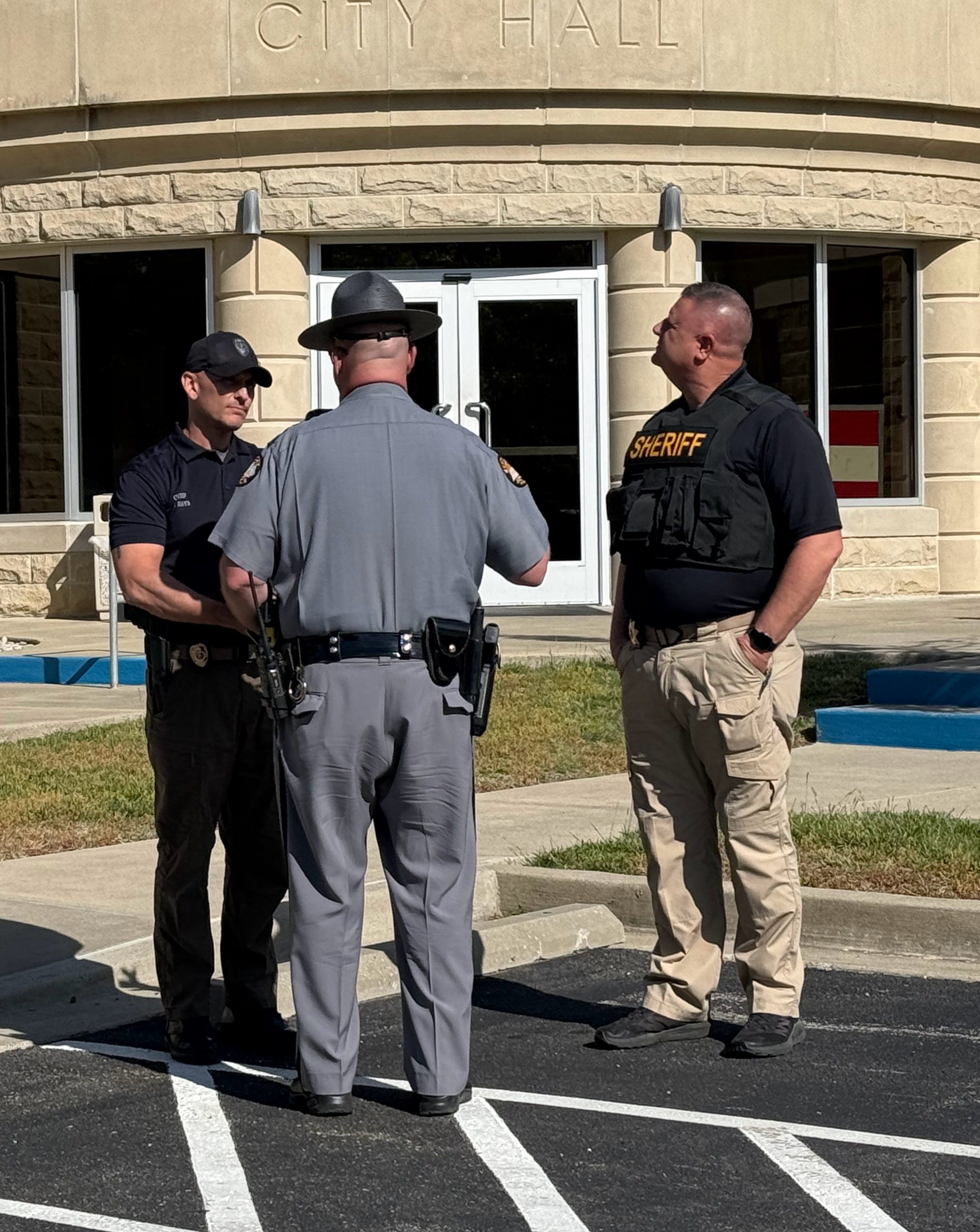
I wasn’t thinking of that at the time I was following the path of law enforcement as they sought the killer, or when, one of my cop friends unexpectedly tipped me off to an FBI media briefing. I hadn’t even known to check for one, so with his help, I was still in the game. Oh, and it is a game. The initial round had started outside of City Hall when the first media briefing brought us the latest updates. These included asides from the sworn-to-protect about how aggravated, so pissed off, they were that this had happened in our town.
The troopers, cops, and all the feds who descended by the dozens on our town all seemed to take these killings personally. Why? The feds aren’t from here. I saw the tension arise immediately when they took charge and claimed this case as their own. It’s more to do with reputation for them.
But our local guys, I’ve gotten to know them over the course of routine reporting on their activities, mostly anodyne and Mayberry. The chief deputy county sheriff and my town’s police chief were the ones to present me with my certificate and medallion when I completed the citizen track at the Police Academy. I got smiles, hugs, and a pat on the back. We were all proud.
I recognize that we are a fairly homogenous society here, but from what I can tell of these men’s characters, they see us as theirs to serve. And when harm befalls us, they see it as their failure. You can hate cops, I get it, but they aren’t two-dimensional. And I really do believe that some of them will go to the ends of the earth for the people they’ve sworn to protect.
The law was out for justice. The media were out for dominance. I watched impressed, as each TV reporter, the same age as my son or even younger, retreated to their respective automobiles to get the latest police scanner news from their producers before zooming off to the chase. Do you know, I am the eldest reporter in the pack these days, in this place, and not by a few years. By decades. I commend them for still wanting to tell stories in today’s world. Or do they just want to be on camera? It’s both, I think.
In between filing stories, I read an email from someone who’d been following my live updates. The reader thanked me for covering the story with sensitivity. That made me wonder what else was happening when those young reporters were filing their pieces. I didn’t have time to compare, not then anyway. I have since. Frankly, I found there was some very fine reporting being done by these young tv journos.
Am I sensitive by nature, or just older and, perhaps, more mature? Or, was this reader misperceiving me? Because in this next round, the kids will have moved on to the next gory story, and there will come the long-form journalists, the same ones from Lexington and Louisville who previously didn’t think our little community was worth their attention. But since I started covering what is going on, they take my work and try to make it theirs. They swoop in and fly out, write what they write, and often with even the basic details wrong. Proximity is accuracy, but it also leads to more investment. And I am invested in telling this tragic story correctly but am not sure how to apply sensitivity to the dilemma I now face that pits competing reporters who do not see a reason to defer to the locals (because, they think, how talented could a local reporter be, really?), with the broken hearts of people who I imagine at this point in their lives think journalists are vultures, and rightly so.
Meanwhile, since this kind of reporting is all new to me, I wasn't sure what I should do once the kid was caught. So, I just did what I normally do: I found the people who were the experts and told them I needed help. Court clerks, a reporter in one of my professional associations with experience covering murders, a lawyer, a trooper, a detention center receptionist, the public information officer for the US attorney’s office in Eastern Kentucky. They all helped me know where to be and what to ask when I got there.
I also learned with surprise, and then annoyance, that some of those tv cubs had gotten a hold of the criminal complaint filed by the feds. Well, now I know, thanks to someone in the US Attorney’s office, I need to buy access to court documents through a subscription program, as the others had.
This man-boy criminal will be formally charged tomorrow afternoon. I think I should be there, in Lexington, to see the start of what will be a long legal process that is the best chance we will have to help mend the rip in the fabric of our community.
Looking at FBI statistics on armed robberies over the past few years, I see that deaths associated with them are rare; some years there are well over a thousand such crimes, but no deaths. Here, we have two in one. This is a story I am sure will become a criminology case study, of interest to true crime buffs (what a weird buff thing).
Yesterday, I saw the headline about this ordeal in a London, UK paper, no less. It is a uniquely American crime: a high speed car chase, a gun, a young man, two deaths. These are not the ingredients found in such combination in other lands, just in the movies they see of us. Yet in the movies, there is a plot, a reason. Why did this young person kill when he didn’t need to kill? Any bank teller knows to hand over the cash without a struggle. It’s only money. According to the criminal report, though, the boy entered the bank with gun drawn, shot first, and only after, scrounged through the teller drawers.
Did this boy, reputedly just sprung from foster care to the north of here (I have not been able to confirm this as of now), only want a deadly thrill or did he need cash?
My “followers” and subscriber numbers were exponentially increased by way of my coverage of this crime. I am morbidly gratified that readers chose to follow how I went about telling this grisly story. But there is still more to report. I have been collecting information that will help me investigate: names of family and friends, employers, bank customers, social media posts by the killer, quotes overheard from law enforcement. FBI statistics, previous crimes in our town.

I am a policy reporter at heart. I study economic and other people-driven systems and how they work, if they are working. Murders are not what I am drawn to. The only reason I am here in the thick of it is because not long after I retreated to my native state to start over, to lick my wounds after heartbreak in Washington where I was a reporter, I noticed there was no dependable news outlet, not even though our town faced a serious land use issue, and people need reliable reporting, and I knew how to do it, so here I am doing what needs to be done, whatever the news. It wasn’t what I had planned to do at this stage in my life, but it is what I am built for, so I am compelled to do it.
Yet in this moment, I feel like I stand outside the door to a world that will require me to see people differently, and to respond differently, too. To do my job differently than before. I will need to talk with people whose hearts are broken. I will be competing with people I find suspect. How do I do these things and not do harm? What will I learn about people that will challenge how I see myself? I will need to examine what is dark and sad. I don’t know if I want to do that. No, I know I don’t. Do I have to? If journalism is a service, the way I think it should be, then I think I do.
I am not heroic, I know that about myself. I will run the other way when the fire starts. But from a distance, I will still watch the pyre rage then turn to ashen ruins. I will examine what went wrong, what could have been done differently for a better outcome. I will use the past to construct what might be a better future. But broken hearts are not systems, and journalists are not therapists. Still, I know pain, loss, and disappointment. These are the wounds that brought me back here. I hope they will be enough qualifications to help me deliver the justice of a story well told, a complete picture of fate, save perhaps the deeper reason for why it happened at all.
Whitney