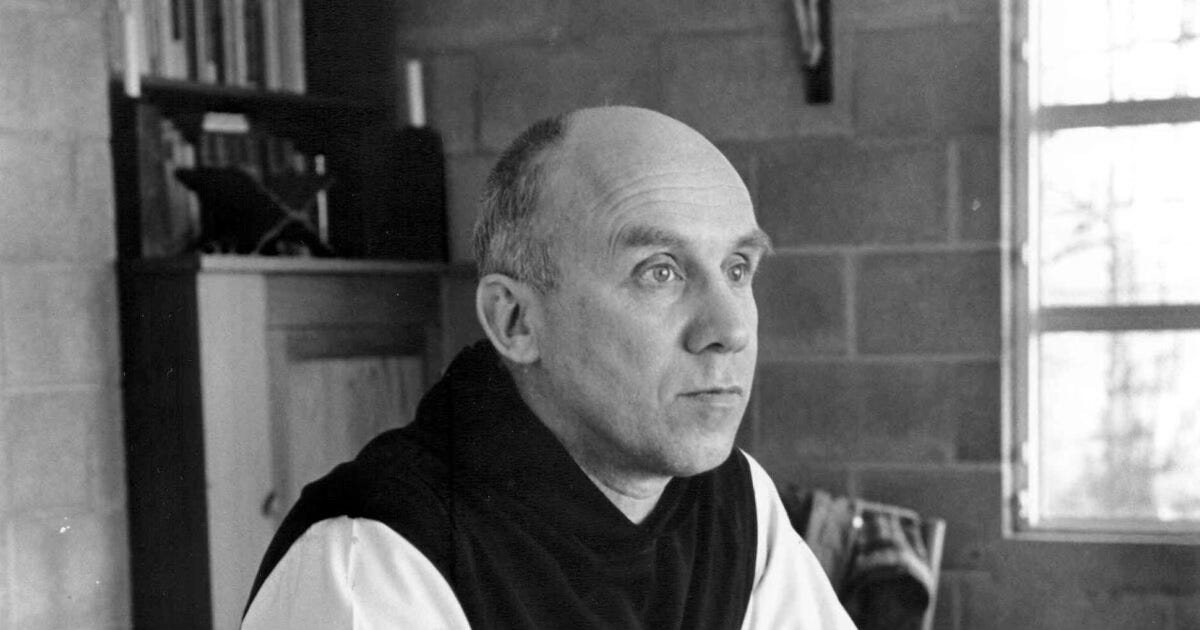
The go-to American monk might not have thought what you think he thought
Some uncommon insights on Thomas Merton

Greetings,
Earlier this year when it was starting to warm up and the trees were in flower, I decided to visit the Holy Land. We have one here in the US. It’s in Kentucky.
The Bourbon Trail runs through it, but that’s not why it’s nicknamed as such. It’s because there where the Bourbon distilleries are scattered across Marion, Washington, and Nelson counties, there also are four religious orders, including Saint Catharine’s which has a massive farm that is marketed by the state as a tourism attraction. It’s also where my mother was a Catholic boarding school student back in the day.
Kentucky was a kind of promise land for Maryland Catholics (Maryland was the only Catholic-founded colony in the US) in the 1700s after the Revolution. Sixty families upped sticks from St. Mary’s County in 1785, made it as far as what is present day Maysville, Kentucky, on the Ohio River, where half of them continued on to Bardstown, and several others scattered into the Bluegrass region.
Similarly, Cincinnati was largely founded by German Catholics and many of them ended up over the river in Covington where, if you really want CATHOLIC, just hang out anywhere in those hills. I did so back in January and was almost disoriented by how much Catholic there was. A church named for one saint or another was on seemingly every street corner. It was a whole other Kentucky from what I am used to here in the hollers where nary a saint is ever mentioned, much less even heard of.
I can get you to my place just by telling you to turn left or right at any number of Baptist or Pentecostal churches—no street names necessary—that are either named for the family that founded them, or for the patch of land where they sit. But never a saint. There’s also one down the road a bit in an old rickety trailer named the Pony Express Church, which I would be too nervous to enter because what do ponies have to do with liturgy? Plus, it’s a bit weedy and hasn’t had a lick of paint in decades, but I do see a few trucks parked beside it on occasion. It might just be a poker club. These things happen. The snake handler church closed down the year before I got here. I have a story about that for another day.
Lots of Catholic Brits, which we don’t hear much about, and not quite as many French Catholics were the “iron pioneers”, as I read someplace that they were called, I guess because of their grit and fortitude. They forged through the Wilderness just as Daniel Boone had done a decade prior, and while Napoleon was trampling Europe, the first inland Diocese in the US was founded in Bardstown in 1808.
Where there are Catholics, there will be religious orders, and that is how the Abbey of Gethsemani, a Cistercian religious order that has its origins in France, came to be south of Bardstown by about a half hour on the country roads that increasingly are less country, more sprawl.
This particular branch of Cistercians are known as Trappists. That’s because, if you read last week’s post, they went through a reformation, and that led to a schism. And where did that schism erupt? La Trappe Abbey in France. This was all about 1604, when the Dutch were about to womp the Brits in the butt in their race to loot and pillage the world with their respective East India companies.
As the two flags of empire popped up all over the globe during their respective commercial fleet’s colonizing sprees, a handful of French monks in Normandie were demanding they be given less things because curlycue architecture and cotton robes that didn’t itch were thought to be corrupting their souls. So, the Order of Cistercians of the Strict Observance, or Trappists, were formed. The Trappists also thought speech was frivolous, so they did away with that, too. Thus, they are also known as the “silent monks”.
So, at the Abbey of Gethsemani, no one talks. And that is what brings me to Thomas Merton, the most famous American monk. He was at Gethsemani from 1941, when he was 27, until his death at age 53 in 1968. During that time, he wrote some 50 books and plenty more commentary and even poems. For a guy who wasn’t supposed to talk, he was voluminous! The man would not shut up, even if it was on paper. How the hell did he end up a Trappist?
I was hoping to know the answer by now, given that I have been hacking my way through his autobiography, The Seven Storey Mountain, which I bought while visiting the Abbey, but am distracted by the fact that he includes what seems to me to be every single detail of his waking life, that is, until he gets to the good parts with all the smoking and drinking, and presumably sex.
He wasn’t even taken with churches, much less religion, until he’d been sprung from boarding school in the Midlands of England, just before he was about to enter Cambridge’s Clare College.
It happens while on a solo trip to Rome when he starts to wander into churches where, the son of a respected New Zealand artist, Owen Merton, he finds actual artistic expression rather than the bluster of the Roman ruins, the architectural Brutalism of Caesar’s day.
Ordinarily, if I can’t get into a book after 30 pages, then I stop reading it because life is too short. But I am 150 pages into Merton’s story about himself, and frustrated, but still plugging along. Why? Well, for one thing, born in 1915, his early life, minus all the details about bullies and more bullies, was exotic by any 1920’s American’s appraisal.
Because his parents were artists, they chased the light to France, where Merton was actually born, and he had the run of the Pyrenees and the Occitanie. To just crawl all over the rocks and rubble of French monasteries before anyone was all about whoring out their towns to tourists, so that you are a young boy alone with your curiosity, and your eye for light and beauty, which he seemed to have—wow.
But also because he manages to be excoriating about himself without being self-deprecating, which intrigues me. The book was originally published in 1948, so he still was a young man, but what I get from reading between the lines is that the author is a guy who is debauched but doesn’t want you to really know just how depraved he actually is. And, he isn’t so sure that he wouldn’t rather be the depraved guy instead of the monk.
He never specifically tells you what he was up to, he just refers to addictively reading novels that are sexy but doesn’t say which ones, and to hanging out in bars and clubs but doesn’t describe drinking anything. He does occasionally tell you about smoking cigarettes, many of them, but honestly, for all his prudish railing against the darkness and sin in the world, and his part in it, he isn’t very specific about his actual sins.
I had to leave Merton temporarily to finally get the scoop.
It was when I looked up how he died—because that has always intrigued me—that I came across a thoughtful professor of religion’s critique of Merton’s final works before he was found dead in his room during a South Asian studies retreat in San Francisco, a mysterious red burn mark down the side of his naked body.
The critique made mention of the child Merton had fathered out of wedlock while he was in his first year at Cambridge. I was shocked. I am past the point in the book where that should have been, but the critique informed me that the Catholic Church did not let him publish that in original drafts of the book. Well, it’s still not in my current draft of the book either.
The fact of this is what prevented Merton from becoming a Franciscan at an order in Olean, NY, which had been his original intent, apparently. But the offer to join that monastery was rescinded when he told them about the child. It is thought that the child and its mother were both killed during Nazi bombings of London during WWII. Or so the story goes.
He also apparently was a very heavy drinker. To the point where he would be too hung over to attend classes, and eventually he was kicked out. His mother was an American, and her family was from Long Island, so that is to where Merton returned before enrolling in Columbia University.
The critique was not fixated on Merton’s sins so much as what the author thought was Merton’s faulty theology, especially towards the end of his life. Merton was, along with Br. David Steindl-Rast, an Austrian Benedictine who, after WWII, helped expand the reputation of a newly founded upstate NY monastery and who is still with us at age 99, interested in finding ways to marry Buddhist teachings with Catholic ones. The author of the critique was just not having it.
But that is what fascinates me about Merton. He is the go-to pop spiritual writer that even today I heard an astrologer on Youtube quoting, and yet, he was most certainly not in the same headspace as his spiritual brethren at the time of his death. He is a pop icon, despite being among the most rigorous intellectuals America never produced but gets to take credit for anyway.
In fact, the man who’d written multiple books and treatises on Catholicism and taught his fellow Trappists with lectures he’d been given dispensation to offer (you gotta talk for those), was starting to drift so far from doctrine that he was alarming many in the upper reaches of the Church, capital C.
He was so taken with Buddhism, his writings to me reflect a man who was on the verge of yet another conversion. And he was glib enough to entrance you with how this was natural because we’re all just spiritual beings at the end of the day.
Quelle horreur! if you’re his abbott. And in fact, the author of the critique noted they fought and that Merton was frank about how unhappy he was at the monastery.
The Catholics are who taught me, nearly 40 years ago now, the Enneagram, and so often when I am reading Merton, the number 7 pops into my head because he is so very much a 7 personality type. Sevens are the philosophers and talkers. To me, Merton seems to have been arrested in his development as a Catholic, and probably was bored, frankly, given that he’d literally written all there was to say about being a Catholic. I’m sad we didn’t get to see how Merton would have evolved, if he were to have evolved: He might have kept with the Catholic Church and tried to ram Buddhism down the Vatican’s throat, in a manner of speaking.
Merton’s death has fascinated me ever since years ago I heard the conspiracy theory that the CIA electrocuted Merton to death by throwing a space heater into the tub with him in it because of his outspoken (and eloquent) opposition to the Viet Nam War. After reading reporter Sy Hersh’s autobiography and watching Laura Poitras’s documentary Cover Up, about Hersh’s reporting on Vietnam, I have no problem believing the weirdoes in the CIA were so full of themselves and their circle jerk war that a mouthy monk would easily be a target.
But it’s just a theory.
My take away after slogging through a third of Merton’s self-story, but also some of his more academic works on Catholicism, is that Merton was achingly intelligent, and had been exposed to so many great works of art, literature, and systems of thought, that he could cast a spell of smart over you, but in the end, what did he really believe?
I don’t think even he knew at the time of his death, untimely and unexpected as it was.
I can’t help but equate Merton with other great minds that were ever-evolving but did not necessarily find resolution. Leonard Bernstein, another personality type seven by my reckoning, comes to mind because of his obvious greatness undermined by his restlessness—not that we suffered for that.
My God, what would the world be like without West Side Story in it? John Lennon, too, could be compared to Merton in that he was also still evolving his philosophy on life, and all its iterations he made public. It’s always made me mad we didn’t get to know whether he would turn out to be an obnoxious troll on society, or a deep thinker who could lead people to work it out, like Bono has proven he is capable of doing.
But I’m also reminded of religious historian and author Karen Armstrong, the former Catholic nun who eventually left the Church due to her religious order actually being a hot bed of abuse, but whose mind was already on to the next thing beyond Catholicism, it seems. She has alighted on the way of compassion as her path of belief, which is possibly where Merton was headed, but we’ll never know.
Whitney