Sing a song of murder
Just ask Dolly Parton about those Appalachian ballads, so like those European operas
Greetings, Friends.
Sorry I skipped out on you last week. Anyone want to guess why…? Yes! Another migraine. But here we are. A lot has happened in between.
First, if you read this piece I wrote a couple of weeks back, the Alabama granny wh was arrested for wearing a penis suit was found not guilty because being a dick, as we well know, is not a crime.
Also, two weekends ago, I attended my first wedding where a man’s pants just let go. I mean, they suddenly puddled at his feet right as he was approaching the lectern to read a Biblical passage to bless the couple. Those of us filling the pews were stunned silent, before bursting into horrified laughter.
As he gave us a tighty whitey butt shot while collecting his trousers from around his ankles, I wasn’t sure whether the elderly man might faint with embarrassment. But no, he buckled himself up, tighter apparently, and made a comment about how one never knows what might happen at weddings before plowing ahead with his reading.
How could the man’s pants just have fallen off? I asked the mother of the bride a week later, and she said he’d told her he’d lost a lot of weight. They do make belts in smaller sizes, but still, no one will forget that wedding.
This weekend, I attended one of the many, many live music performances that proliferate through our little town where more people know how to fiddle or finger pick than anywhere else on the planet except maybe Nashville. And some from Nashville come back here to play. The photo above is of the free cozy concert, which was given in an art gallery-retail store in the frou-frou part of town, which is about one block wide. The little one danced and kept time on her pint-sized guitar for each song until her papaw turned up and she dropped her instrument and ran squealing to see him.
For the most part, the band played upbeat bluegrass (is that redundant?) tunes like Blue Moon of Kentucky, or upbeat bluegrass covers of Tom Petty and Bob Dylan. But they squeezed in a classic Appalachian ballad, The Banks of the Ohio. You might know that song as a murder ballad, because that is what it is. But, Appalachian ballads are the same thing, euphemistically speaking.
A friend from North Carolina was sitting next to me. I said, did you know Dolly Parton sings this one. She didn’t but she laughed and said, there are so many of these ballads. That’s what Dolly said, I told her. Appalachian ballads are murder confessions sung by men who drowned, shot, slashed, or bludgeoned their women to death. And there are thousands of them.
I didn’t grow up here where I was born, but I still grew up in the 1970s South Florida, where despite what you might have heard about the place, I did get an excellent public education which included learning how to read music, and to sing many American folks songs. So, I knew the Banks of the Ohio from when I was a kid, and was disturbed by it, but I hadn’t known it wasn’t aberrant, just a pedestrian tale of femicide, until I heard Dolly talking about it on an episode of Dolly Parton’s America produced by WNYC.
There are some variations on the lyrics, but the plot line is always the same:
I asked my love to take a walk
Just to walk a little way
As we talked of our future wedding day
And when she said she could never be mine
I placed a knife against her breast
As into my arms she pressed
She cried oh please don't murder me
I'm not prepared for eternity
Well, of course he does kill her, and presumably rolls her body into the river. As he’s walking home, it occurs to him he’s a murderous moron:
I cried my God what have I done
I've killed the only one I loved
Because she would not be my bride
Many of these ballads can be traced back to Britain, according to this historical account. Are they all true? Not sure, but it’s a common theme, so the urge of a man to kill a woman is apparently very real. I’d say it’s perhaps a human urge to kill, but there aren’t murder ballads composed and sung by women.
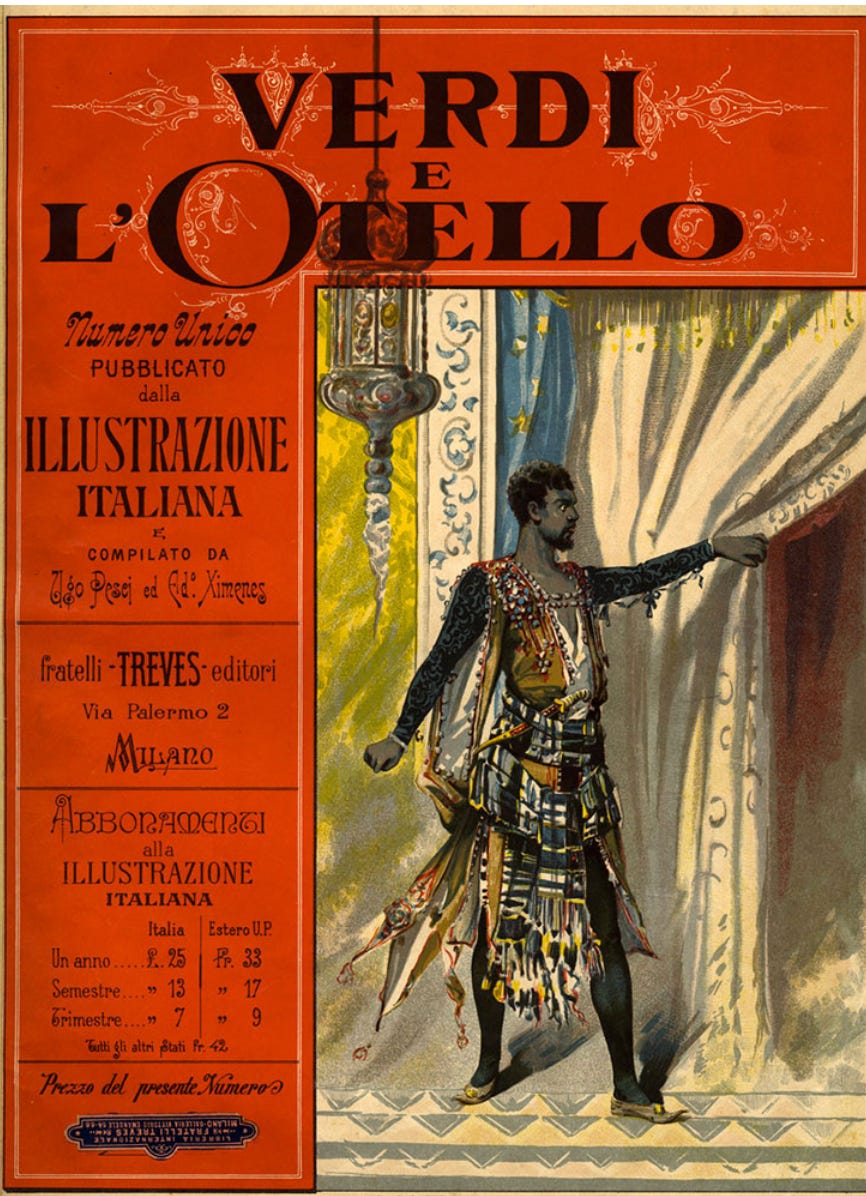
Listening to the band play this tune (upbeat and bluegrass, weirdly), it occurred to me that so many operas I’ve seen or listened to in my life are a variation on this theme. The most obvious one is Verdi’s version of Shakespeare’s Otello, where the Moorish king is duped by Iago into murdering his wife, Desdemona, in a jealous rage.
But that’s not the only dame Verdi kills off. There’s Violetta in La Traviata who dies of consumption. And let’s not forget Verdi’s Aida who is buried alive. Puccini’s Madama Butterfly also dies (suicide), as does Tosca (suicide), and Mimi in La Boheme (consumption, again). In Donizetti’s Lucia di Lamermoor, Lucia dies amid a murder-suicide, and refreshingly is not the one murdered; she just dies of a broken heart. Bellini’s Norma dies in a pyre, and weird and wonderful Wagner kills off Isolde in a metaphysical orgasm so total, there is nothing left to live for. Wagner also ditches Senta off a cliff in The Flying Dutchman—more suicide.
As a side note, French critics lost their shit during the Belle Époque when Werther, the Goethe character brought to life and then death by suicide when the eponymous opera by Massenet was premiered. Why? The opera depicted a man killing himself, how gauche. But women? Either kill them, or let them kill themselves.
I am not really sure how to tie this up in a tightly drawn narrative lesson. What is there left to say about how ingrained in our culture violence toward women is? It’s just that I happened to notice for the first time, the parallel between mountain murder ballads and sophisticated European operas with death arias as the climactic scene. Murdering women is not just for poor men, wealthy ones are in on it, too.
I’ll tell you one take away that occurs to me, and that’s mistreatment of women at the hands of exonerated men, in America, in Britain, in Europe, is depicted as a fact of life.
And yet we know better.
Peace,
Whitney