
Brooklyn
Based on Irish novelist Colm Toíbín's novel, the movie is a quiet, classic American story about rising above one's self to become authentic, and a memento of who we once knew ourselves to be


Warning: Spoilers abound
Hello, Friends.
I soon will need to deal with a woman whom I abjectly detest because she lies and is phony and will make trouble just for her amusement, or because she thinks it makes her look blameless.
Yesterday, as I was dreading the encounter, the movie Brooklyn came to mind—specifically, the scene where the abhorrent Mrs. Kelly, played by Bríd Brennan, tries to leverage a morsel of information about something that has nothing to do with her, to create pain for Saoirse Ronan’s character, Eilis, just because it thrills the nasty woman to hurt people.
When I saw the movie more than 10 years ago (it came out in 2015), Ronan’s character in that moment when Mrs. Kelly meddles in her life made such an impression on me. Since then, I’ve encountered a couple of Mrs. Kellys, and I wondered if the young Eilis’s stern response would impress me the same way today.
So, I re-watched Brooklyn.
Women in Ireland at that time were expected to do as they were told. It was a time and place where unmarried women who became pregnant were locked away from society, their newborns smothered and buried in mass graves, or stolen from them and adopted out to Americans for a fee charged by the Catholic Church that was used to fund the self same operation of infanticide and shame.
In fact, it wasn’t at all how I remembered it.
Why is that—is it because my brain, like the brains of probably more of us than less of us, has been so scrambled in the past decade by the inherent gaslighting of a mafia state masquerading as a democracy—can’t be trusted to accurately recall non-important information?
Or, is it because it’s not my brain, it’s a natural consequence of the privilege of aging? In other words, is it that I have matured not just in body, but in mind and outlook, and so don’t take in the world the same way?
And so I wonder, do the artistic expressions we once felt an attachment to, such as movies, novels, and paintings, age with us?
Based on Colm Toíbín’s novel of the same name, written for the screen by the brilliant Nick Hornby, I thought Brooklyn was a lovely movie the first time I saw it, but at that time, I only watched it at face value. As such, what I saw was a sweet and tender coming-of-age love story set in the early 1950s, where a desperately homesick young Irish woman named Eilis (pronounced Ay-lish), living in Brooklyn, falls in love with a polite and charming Italian-American plumber, and eventually realizes she wants to be with him in America, even if it means well and truly saying goodbye to Ireland.
I had thought it was well acted with a beautiful but not exquisitely so, cast. Not glamorous at all, which made it believable. I also remember thinking the mother, played by Jane Brennan, was overbearing.
This time, my heart broke for nearly all of them, especially the mother, a widow, who is not in the least overbearing, but is dignified and kind in her grief after the death of her eldest daughter and the emigration of her youngest.
Tony, played by Emory Cohen, was the exception. That’s because last summer I read Long Island, the sequel to Brooklyn, and I know what a disappointment Tony turns out to be as a husband, how he has affairs and hurts Eilis.
Why Eilis was in Brooklyn at all was to do with her older sister, Rose, who arranged for Eilis to go to America where there is more opportunity for her than in Enniscorthy, County Wexford. Through the largesse of an Irish Catholic priest in America, played by Jim Broadbent, Eilis becomes established in her new homeland.
To do this, the priest had directed a few wealthy parishioners who were atoning for various sins, to cover the cost of Eilis’s room and board in a women’s boarding house (run by Mrs. Kehoe, the delightful, can’t-ever-get-enough-of Julie Walters), and her tuition at Brooklyn College where she takes night classes in order to become an accountant. But Rose dies unexpectedly, and although she is too far away to return in time for the funeral, Eilis returns to comfort her mother. By then, Eilis has secretly married Tony.
Pulling the lens back a moment, consider that the end of WWII was still fresh on everyone’s mind at this moment in history, and that Ireland was still essentially a colony—no longer the Queen’s, but still that of the Catholic Church which hadn't yet been reformed by Pope John Paul I, and so held the Mass in Latin, said by priests who kept their backs to the parishioners.
It was a time and place where unmarried Irish women who became pregnant were locked away from society, their newborns smothered and buried in mass graves, or stolen from them and adopted out to childless, wealthy Americans for a fee charged by the Catholic Church that was used to fund the self same operation of infanticide and shame.
Women in Ireland at that time were expected to do as they were told. There were not many opportunities for anyone, especially bright young women, and so an exodus was in full force, either to Liverpool, North America, typically to New York, but also to Canadian cities. Occasionally they would move to London, but that city was still coping with having been decimated by Nazi bombings and was a place depressed and grieving.
These times are depicted in harrowing detail in Fintan O’Toole’s We Don’t Know Ourselves, a sometimes brutal tale of modern Irish history, which I do recommend. And of course, there is the Steve Coogan, Judi Densch tragicomedy, Philomena, which is based on the true story of a woman whose son was stolen from her and adopted out to Americans by Irish Catholic nuns in the 1960s.
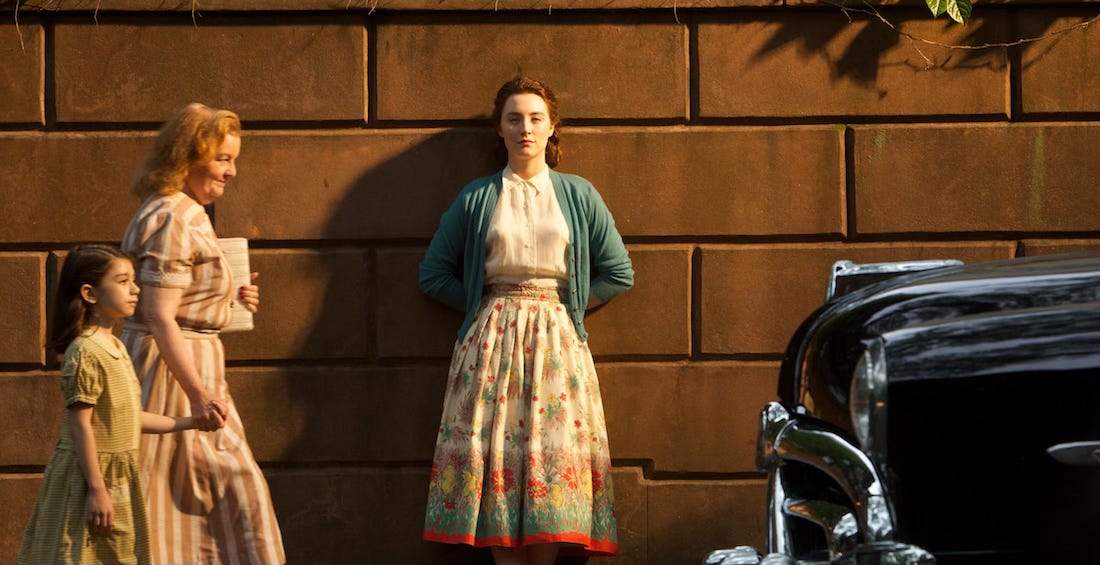
In a cinematically sweeping film that captures the borough during its bustling heyday, Brooklyn’s French-Canadian cinematographer, Yves Bélanger, partners with French-British costumer Odile Dicks-Mireaux, and Irish director John Crowley to employ jewel tones set amongst slightly sepia colored crowds of other immigrants, the movie subtly communicates the historical subtext that Eilish ultimately is going to rise above, using the colors of the clothing she and those she encounters are wearing.
Eilis is trying to make a life for herself in Brooklyn, but she did not choose this; she is simply doing as she was told to do by her beloved sister. Her homesickness is so acute, she is mute with heartbreak, which at one point reduces her to tears as she stands at her post as a luxury department store clerk.
Home is still home for her, and as she moves through her days in Brooklyn, Eilis wears her Irishness like a mantle: she is always dressed in a plush emerald green overcoat—the deep green of Éire (the Irish name for Ireland)—causing her to stand out in the drab throngs marching through the city crosswalks.
I looked for evidence that this leveraging of color as a clue—similar to how mythologist Martin Shaw uses the Red, the Black, and the White in his storytelling to indicate the Jungian puer, senex, and the transcendent—was done on purpose, but I could find no discussion of their use of color other than an interview with Dicks-Mireaux where she referred obliquely to color while discussing how colorful fresh fruit was placed in the scenes of Brooklyn streets with their open markets, contrasting with the lack of fresh food in Ireland.
And yet, it’s so effective.
Once Eilish realizes she’s in love with Tony, she is never seen in her green overcoat again. Instead, she begins wearing a deep red one, which parallels the timeline of her passionate awakening. Tony, meanwhile, is the one who begins dressing in deep emerald chambray shirts, and dark brown trousers. He is, I took that to mean, becoming her new homeland.
Once she meets Tony, Eilis no longer cries tears for Ireland, and is not seen in green again until after the arrival of the news that her sister has died, and then it is her blouse which is a dull green, which I saw as her sorrow over her sister and her renewed longing for Ireland being what was now closest to her heart, possibly even coming between it and Tony.
Once Eilis has returned to Ireland, Mary Lacy, Eilis’s mother, now not only a widow, but a mother who has outlived her eldest daughter, clings to the return of her remaining child. Mary is forever dressed in an acid green cardigan atop a burnt red patterned dress. So much has gone off in her life, the colors are not right.
The deep green of home, the flaming passion felt away from it in America, the spoilt colors for the women left behind—I won’t belabor the thematic use of color, except to say I saw it in every scene, and so do believe the filmmakers knew what they were doing with it.
Eilis keeps her new identity as a married woman to herself as she extends her stay in Enniscorthy, in part to comfort her mother, in part to attend the wedding of her best childhood friend, but also because she is being courted by the wealthiest boy in town who turns out to be thoughtful and kind hearted, not the entitled prick she expects him to be.
And so we have the dilemma: should Eilis stay or go back? Where is her true home?
That she is married should place a moral sword of Damocles above her head, but it doesn’t seem to, which upon watching it this time around stood out to me. She is quite comfortable allowing Jim Farrell, played by the always affable Domhnall Gleeson, to believe they have a future together.
For a girl who throughout the film is lauded for her thoughtfulness and capacity to endure all things dutifully, this seems out of character. It is out of character, too, for a 1950s Irish woman to have so many choices, all of them good. This is what truly sets her apart from Mrs. Kelly, who has chosen to lean hard into the unfairness of their world. Does this indicate Eilis is no longer Irish, but has become an American in her heart at last?
Eilis, as O’Toole’s poignant history of Ireland and its exodus drives home about 20th Century Irish folk especially, doesn’t seem to know who she is.
Until she is called for a meeting with the bitter snipe Mrs. Kelly who has learned the truth about Eilis, that she is in fact, a married woman. And that she married an Italian, God help us. This is the moment I had specifically set out to rewatch the movie for. Somehow, I had remembered that Eilis ends Mrs. Kelly’s reverie of snotty triumph with an Irish salute, “Feck off you crusty bitch,” or the like. But it is the crucial moment for Eilis more than it is putting Mrs. Kelly in her place.
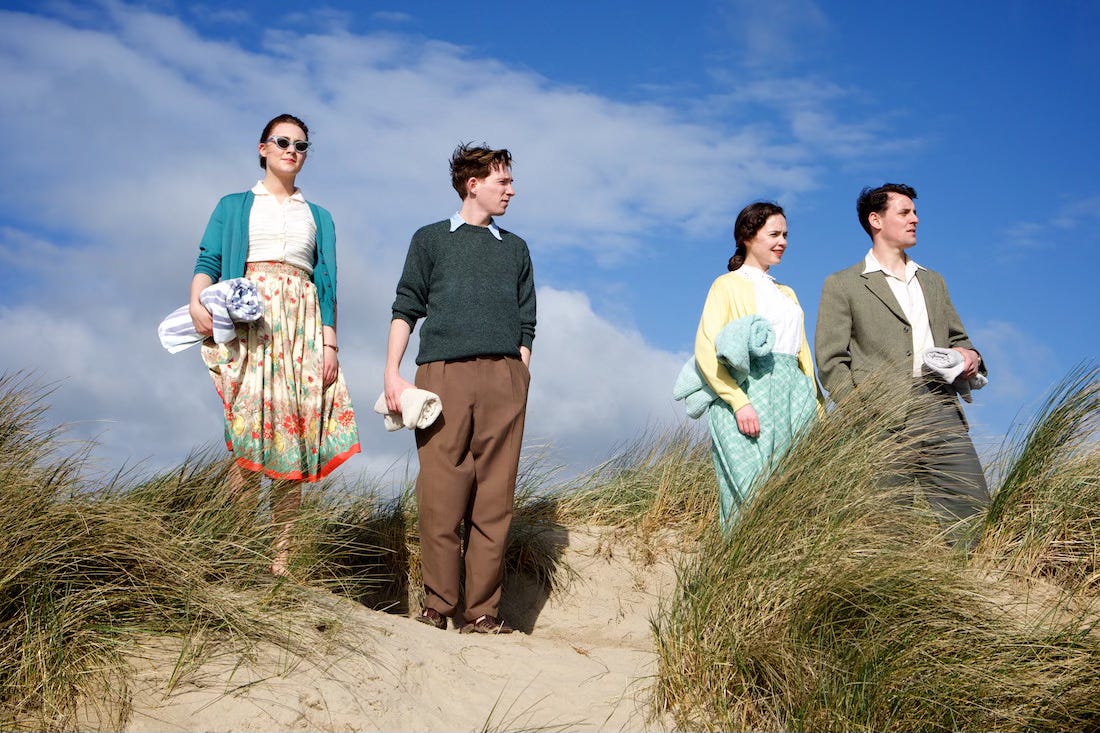
Eilis, who earlier has said she’d forgotten what the lovely solitude of the Enniscorthy beach is like, now says that she’d forgotten what the town is like. In fact, if the town’s character were as awful as Mrs. Kelly’s we’ve not been shown this. It is clear that if Eilis stays in Enniscorthy, she will be loved and cherished by Jim and by her mother. She will be a modern girl with a job as the bookkeeper for the town’s largest employer. This while at the same time, she will enjoy the luxuries of living with Jim in the town’s largest and grandest home, and her in-laws will lovingly fuss over her when they visit her and Jim from their home in the countryside.
So, on this point, Eilis gets it wrong, if you ask me. It is not the town’s status quo that she rejects, whether or not she realizes it. Similarly, the town has not rejected her, quite the opposite. It’s that she is no longer of the place. Having been backed into the corner, Eilis comes out as her true self, and it is not the girl from Enniscorthy.
“What were you planning to do with this information?” Eilis asks before she stands abruptly, and says defiantly, “My name is Eilis Fiorello,” and walks out on a stunned Mrs. Kelly.
Before she returns to Brooklyn, Eilis confesses the truth of her life, and that she must return to it, to her mother who accepts this latest heartbreak with grace. She tells her daughter she will only say goodbye to her one time, and excuses herself to retreat into her bedroom while Eilis is left alone to pack.
The strength of her mercy, forgiving her daughter for not being truthful with her, and the blessing she gives her even though she will now be utterly alone, gutted me. Before the Digital Age, goodbye meant goodbye. How many sons and daughters until even as recent as the 1990s bid farewell to their families never again to know one another’s fate?
The movie landed harder with me than the first time around, even though it hadn’t occurred to me that it would. Since I hadn’t watched the movie initially with any sense of history, I hadn’t set out to watch it a second time anticipating the contextual clues I’ve included in this analysis of the film.
But I’ve changed so much since 2015. I’ve left my beloved home in Washington, death has taken a loved one, and other tragedies have spoilt my colors. But I also have had a few university level courses on Celtic mythologies, and learned to speak rudimentary Irish so that I am capable of shaping its music into being, and I have read some history about my ancestral lands. I can see this tale through the objective lens of academia, the felt experience of cultural myth, and the cursed bloodlines of my forebears.
And perhaps most resonant of all is that I have lost my country, too. Watching the uneasy mingling of the Irish—who as the priest tells Eilis, include the old and family-less men who left Ireland behind to build the bridges and tunnels of New York—with the Italians, and knowing that in time they eventually assimilate, even if it is not an easy assimilation, and that America is better for it, struck me for what it has become: mere nostalgia.
But it felt so good to be reminded of who I know us all to be, in our heart of hearts.
And then there is my own Mrs. Kelly. I have no choice but to interact with her soon, this woman who once stopped me in the street to literally hiss an accusation at me, when I’d done nothing wrong. But a woman who hides behind the sanctity of her church—hers is the Christian Nationalist one—and tosses threats around like Mardi Gras treats, is not a woman whose character has been forged by her dilemmas. If anything, she is a weakling whose inability to grant grace and mercy keeps her mutated. Oh, America, I do grieve you, and I bless the day you will rise up and say your new name, once again.
OMG this essay is so gorgeous. It is a perfect piece of writing. Perfect. x