

Greetings,
Phew, November is here at last. October felt like a swell that never hit the shore, probably because it’s five weeks long. But now the wave has crashed and the tide is running out on the year. And yet, my To Do list is still so long. I am still hacking at the enormous amount of unread email I have.
I read through so. much. stuff. this weekend while clearing out said inbox, I kept thinking over and again, how grateful I am that you spend one of your most precious resources—time—reading my thoughts. You could be doing so many other things. But I guess not many people are writing books about alien consciousness. And yet…
The last installment of the overview from my current book proposal, which (to my surprised, but cautious delight, because I can offer that to the agent as proof this is salable) has been popular with readers, is here.
Pulling away from my own work and viewing it from a distant lens, is it fair to say it’s something like a mash up of Original Sin meets the life of Siddartha Gautama meets Metropolis, Fritz Lang’s silent black and white German film that, in my opinion, with its army of mechanical drones who would do as instructed, the martyrdom of the robot woman at the burning stake, the machine, the tension between the individual v. the Group Mind, it all warned of Hitler’s coming war and the military industrial complex to follow…? Well, that’s what I am going with.
The first time I saw Metropolis was in Le Chat Noir, on Wisconsin Ave., just after Fessenden Street and before Ellicott, near where DC becomes Maryland—about ten blocks away. Is Le Chat still there? I don’t know, but it was one of the eccentric little restaurants in about a three block radius in the Tenleytown area of Washington where certain dependable dishes became go-tos for me when I lived there. Le Chat’s steak frittes was my fave, and perhaps a Bourdeaux red to wash it down. And a silent film. The restaurant’s proprietor played them on the wall upstairs where I tended to sit.
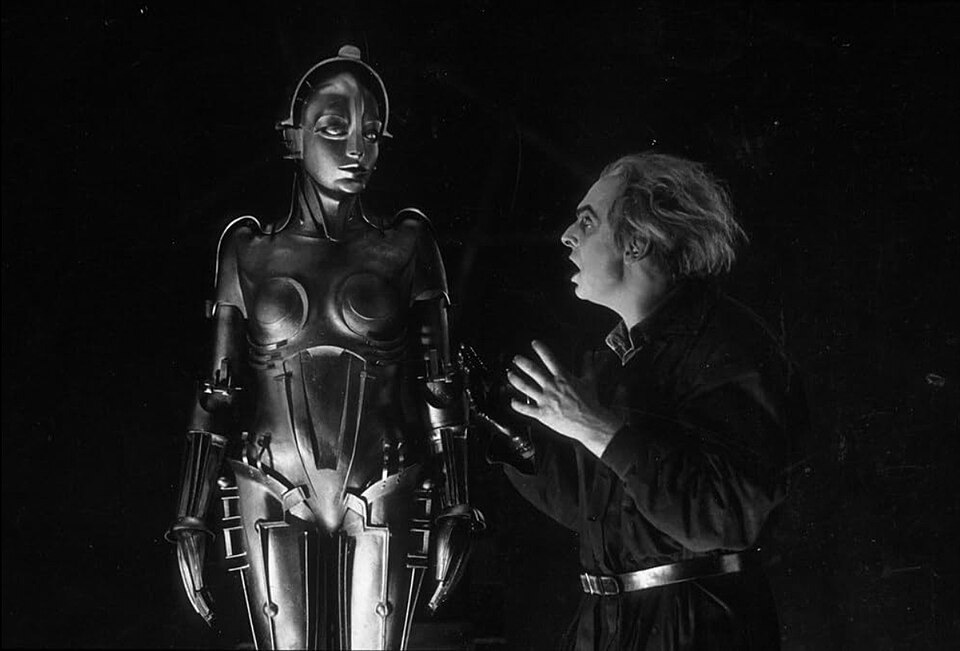
I was transfixed by the space age beauty of the machine-man and the massive sky scrapers towering over the little mechanized people dance-moving like an animate machine, because that is what they were. It all looked familiar.
The movie is nearly 100 years old, and even without dialogue, it tells a contemporary tale of wealth subverting the ones who cannot see to the top of the massive structures built by the commoners, but ruled by the wealthy + a crazed scientist (tech brahs?).
It reminds me of the story of Buddha because one of the protagonists is a spoiled prince of industry whose complacency is rocked when a group of workers catch a glimpse of his opulent life, he takes a forbidden trip beyond the walls of his penthouse into the streets, where he sees an industrial accident and hallucinates that the resultant dead workers are being fed to a monster named Moloch. I don’t know much about Moloch other than he’s associated with the Old Testament and human sacrifice.
Okay, so now the truth is out about the who and the what of all this inequality, and a race to kill one or the other is afoot, a class war to end all wars. Based on the novel by Thea von Herbou, the theme that flashes on titles at various points is, “The Mediator Between the Head and the Hands Must Be the Heart”.
I am describing the film here because, as I note in the final installment of this overview, I don’t think I am saying much that hasn’t been considered before. It’s just that it all engenders the question, Why are we on this merry-go-round and how do we get off? That’s the quandary I am focused on.
From a review I found online, the critic describes the end of the film as a “…peaceful redemption, for the workers have won out over the seductions of rogue technology…” which for us today, is a real threat (AI) that I don’t see us making peace with in our life time. Were humans to overcome this hell that has been unleashed upon us, and notably without our permission, then we would be the ones controlling it, not the invisible ones atop the tower. Which is why, unlike the creatives behind Metropolis, I don’t see the forgiveness and reconciliation happening between the overlords and the rest of us.
What I do see, as I lay out in the proposal, is essentially ignoring the ones in the way, which I think can be done more easily than we believe is possible. Or I am just utterly out of touch with reality.
